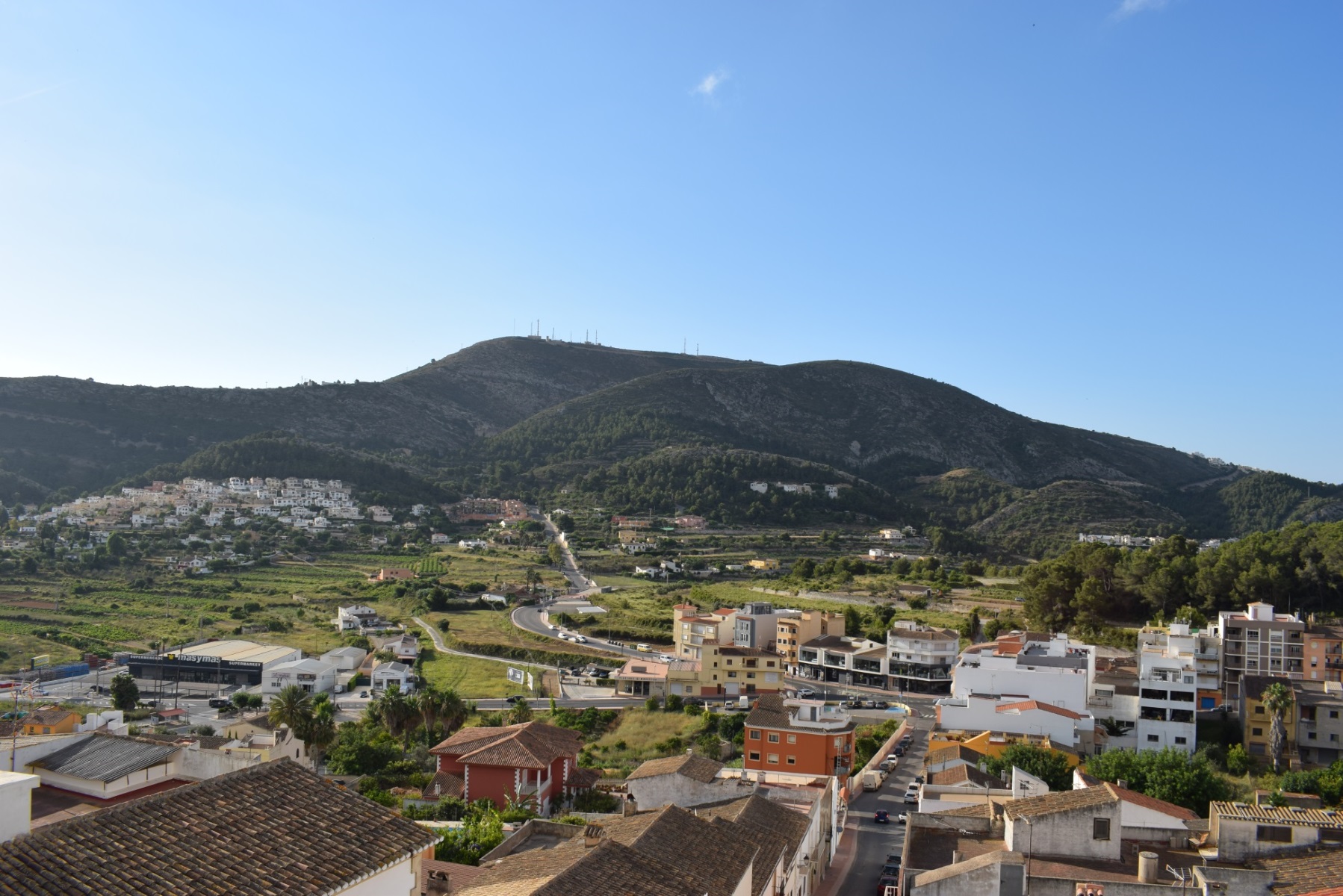
The Serra de la Llorença is a narrow mountain range extending approximately five kilometres southwards as a geographical continuation of Cap de la Nau, separating the depression of El Poble Nou de Benitatxell from the sea. Its highest point is Puig Llorença, which reaches an altitude of 440 metres and lies just 1.5 kilometres from the coast in a straight line.
A balcony overlooking the Mediterranean
The summit’s proximity to the sea makes Puig Llorença an exceptional natural viewpoint. From its highest points, visitors can enjoy an extensive 360-degree panorama over the Marina Alta and neighbouring areas. On particularly clear days, even the Balearic Islands can be seen in the distance.
The panorama encompasses some of the Mediterranean landscape’s most recognisable landmarks, including Montgó, Cap de Sant Antoni, Cap de la Nau and Penyal d’Ifac, as well as extensive views of both the coastline and the inland areas of the Marina Alta.
A mosaic of landscapes
The rugged terrain and proximity to the Mediterranean create a remarkable diversity of environments. Within just a few kilometres, the landscape encompasses summits, sunny and shaded slopes, rocky ravines, caves, old agricultural terraces, coves and towering sea cliffs.
This variety of terrain supports plant communities adapted to very different conditions. On the sunniest slopes, Mediterranean scrubland predominates, with species such as kermes oak, rosemary, heath and Mediterranean dwarf palm, together with other plants adapted to dry conditions.
On shaded slopes and at the bottom of ravines, where moisture is better retained, species such as mastic, Mediterranean buckthorn and wild olive can be found, alongside carob and olive trees associated with the area’s traditional agricultural landscape.
The agricultural landscape
For generations, the slopes of the range were transformed through the construction of agricultural terraces and dry-stone walls, allowing even the most difficult terrain to be cultivated. Carob trees, olive trees and other traditional dryland crops were once a familiar part of this landscape.
As agricultural activity gradually declined, many of these terraces were recolonised by Mediterranean vegetation, creating a landscape where traces of human activity coexist with the natural regeneration of the mountainside.
The Camí de la Serp – Puig de la Llorença – Cala Llebeig Route offers an opportunity to discover part of this heritage, passing along old mule tracks and through agricultural terraces, lime kilns and former stone-quarrying areas.
Mediterranean wildlife
The variety of habitats found in the Serra de la Llorença also supports a rich diversity of wildlife. Reptiles, small birds and birds of prey can be observed among the scrubland, rocky areas, ravines and cliffs, together with mammals that are mainly active at night.
Rock faces and cliffs provide particularly suitable habitats for birds associated with rocky environments. Along the coastal Penya-segats de la Marina, there are also caves of interest for bats and habitats of considerable importance for the conservation of Mediterranean biodiversity.
From the mountains to the cliffs
Towards the sea, the Serra de la Llorença descends dramatically to form one of the municipality’s most spectacular landscapes, characterised by towering rock faces, ravines and coves such as Moraig, Testos and Llebeig.
This stretch of coastline forms part of the protected Penya-segats de la Marina area, where cliff habitats, sea caves and valuable underwater ecosystems are preserved, including Posidonia oceanica seagrass meadows, as well as plant species of particular ecological interest.
The Serra de la Llorença therefore encapsulates much of the landscape identity of El Poble Nou de Benitatxell: mountains and sea brought together in a territory shaped by geology, agriculture and centuries of coexistence with a particularly rugged Mediterranean environment.