

ES
EN
VA
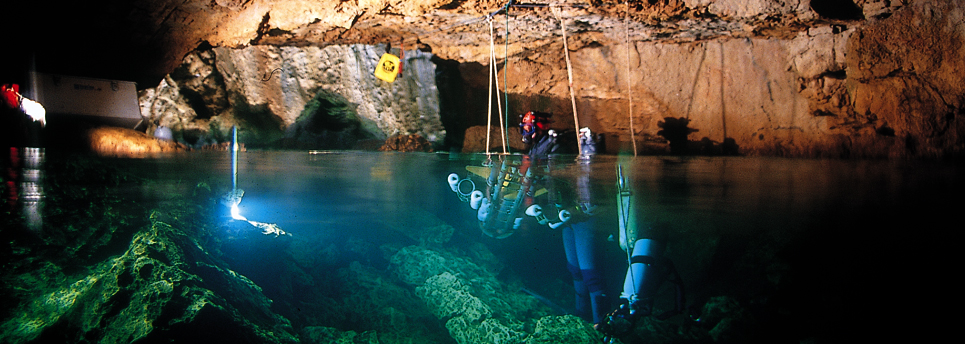
The Riu del Moraig, also known as the Riu Blanc, is a remarkable underground river whose submarine spring lies beside Cala del Moraig. Its extensive network of completely submerged passages forms part of the Benissa aquifer and extends for several kilometres underground, making it one of the most fascinating and distinctive hydrogeological sites along the coastline.
Near the Cova dels Arcs, just a few metres to the south, lies the entrance to the Moraig underground river, also known as the Riu Blanc. It is an active submarine spring and one of the main discharge points through which the Benissa aquifer releases water into the sea. Its outlet is located next to the vertical wall of the Moraig Fault. IGME
The cave consists of an extensive network of completely submerged galleries and passages. Successive explorations have gradually expanded our knowledge of the system. In April 2025, the Moraig Exploration Group (GEM)reached 3,060 metres from the marine entrance, surpassing the 2,800 metres achieved in 2023. During that expedition, 260 metres of new galleries were documented and, including the different branches studied since 2013, the group had explored approximately 6 km of passages. El Poble Nou de Benitatxell Town Council
The Benissa aquifer covers an area of approximately 270 km² and extends beneath a large part of the Marina Alta region. It consists mainly of highly fractured and karstified carbonate rocks, allowing water to circulate through cracks, passages and underground cavities.
As a coastal aquifer hydraulically connected to the Mediterranean, its underground freshwater comes into contact with seawater. This interaction explains the high salinity that can occur in the Riu Blanc and means that it can be described as a brackish groundwater spring. The IGME also notes that water does not only flow out towards the sea through its main passage; seawater can also enter the aquifer through it. IGME
One of the key elements in understanding this system is the Toix submarine sinkhole, located at Morro de Toix, south of Calp. Hydrogeological studies link this area to the functioning of the Benissa depression aquifer system and to the movement of seawater into the aquifer. However, the exact course of all the underground passages remains unknown, so it should not be imagined as a single continuous river or gallery running between Toix and Moraig. IGME
The network of galleries, sinkholes, shafts and branches makes the Riu Blanc a site of extraordinary scientific interest, particularly because of the complex interaction between continental groundwater and the Mediterranean Sea. The Geological and Mining Institute of Spain includes it in the Spanish Inventory of Sites of Geological Interest and assigns it a very high scientific value. IGME
Rather than describing it as a phenomenon “unique in the world” or attributing to it a European record that is difficult to substantiate, it is more accurate to highlight its hydrogeological uniqueness and the exceptional extent of its system of underwater galleries, whose configuration is still being investigated.
In the late 1990s, major hydrogeological studies were carried out to gain a better understanding of the Benissa depression aquifer. Equipment capable of recording parameters such as temperature, conductivity, pressure, and the intensity and direction of water flow over extended periods was installed in the Moraig and Toix cavities.
These studies provided a better understanding of the complex relationship between freshwater and seawater within the aquifer. The Moraig spring is its main discharge point into the Mediterranean and can reach flow rates exceeding 1,000 litres per second. IGME
Current research is not limited to mapping the galleries. Specialists from different disciplines also take part in GEM expeditions and, in 2025, researchers from the Cavanilles Institute of Biodiversity and Evolutionary Biology at the University of Valencia collaborated in the study of the cave’s subterranean aquatic fauna. El Poble Nou de Benitatxell Town Council
The first cave-diving investigations date back to the 1970s. Over the years, different specialists gradually expanded our knowledge of the system.
Among the explorers who played a particularly important role were José María Cortés and Bernhard Pack, who reached 1,125 metres from the entrance. A British team subsequently reached 1,350 metres. Pack lost his life in 1992 during a dive in the Moraig, leaving behind important documentation on the cave and the functioning of the aquifer. El Poble Nou de Benitatxell Town Council
Since 2013, the Moraig Exploration Group (GEM) has continued this work through numerous expeditions. In 2023, the group reached 2,800 metres from the entrance and, in April 2025, established a new exploration limit at 3,060 metres, reaching beneath the Puig Llorença area. El Poble Nou de Benitatxell Town Council
Exploration of the Riu Blanc is restricted to highly specialised cave divers with specific training and equipment. It is a completely submerged cave where current and visibility conditions can vary considerably and where, once inside the system, there is no direct access to the surface for long distances. GEM expeditions themselves depend on very specific hydrological conditions in order to take place. El Poble Nou de Benitatxell Town Council
Almost half a century after the first explorations, many questions about the Riu Blanc remain unanswered. Each new expedition helps to extend its mapping and improve our understanding of the aquifer, but a significant part of this extraordinary underground system still remains to be discovered. El Poble Nou de Benitatxell Town Council
You have 0 favourites in your list.
View the full list in My favourites.

Add your favourite places to your list. You can then manage them and send them to your mobile from My favourites.