

ES
EN
VA
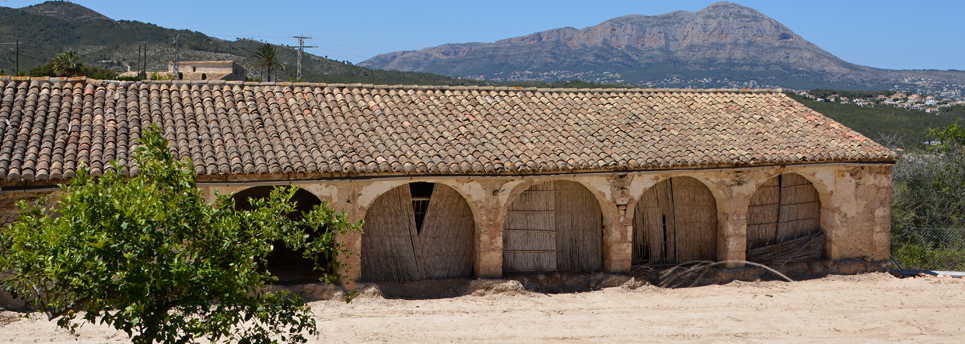
Riuraus are among the most distinctive features of the rural landscape of El Poble Nou de Benitatxell and a symbol of its agricultural past. Traditionally associated with raisin production, their characteristic arches were used to protect the grapes during the drying process and today form an important part of the architectural and ethnographic heritage of the Marina Alta.
The riurau is one of the most distinctive traditional buildings of El Poble Nou de Benitatxell and the Marina Alta as a whole. Its characteristic architecture is closely linked to the cultivation of Muscat grapes and the production of raisins, an activity that profoundly transformed the region’s economy, landscape and society during the 19th and early 20th centuries.
More than simply an agricultural building, the riurau reflects an entire way of life. Its arches, orientation and covered space were designed to meet a very specific need: protecting the grapes during the traditional raisin-making process.
For generations, Muscat grapes were grown extensively in the fields of Benitatxell and other municipalities throughout the Marina Alta.
After the grape harvest, the process of turning the grapes into raisins began. One of its most characteristic stages was l’escaldà, in which bunches of grapes were briefly scalded in boiling water to slightly crack the skin and facilitate the subsequent drying process.
The grapes were then carefully spread over reed trays known as canyissos, which were placed in the sun for several days. The bunches had to be turned and monitored until they reached the required level of dehydration.
Weather conditions were crucial. An unexpected shower or excessive humidity could quickly ruin the crop. The essential function of the riurau arose directly from this need for protection.
A riurau generally consists of a covered portico formed by a succession of arches, usually semicircular or segmental, beneath a tiled roof with one or two slopes.
When rain threatened or humidity increased, the reed trays laden with grapes could quickly be moved from the open air into the riurau, where they remained protected while still receiving the ventilation required for the drying process.
The large arches encouraged air circulation, while the orientation of the building was chosen to take advantage of favourable sunlight and reduce exposure to humidity.
Every element of its architecture therefore served a practical purpose, making the riurau an excellent example of traditional architecture adapted to climate and agricultural activity.
Riuraus could take different forms. In many cases, they formed part of a traditional rural dwelling known locally as a caseta, attached either to the main façade or to one of its sides.
Freestanding riuraus were also built, particularly when larger spaces were needed to accommodate the numerous reed trays used during the raisin-making season.
They were once widespread throughout El Poble Nou de Benitatxell. The examples that survive today are generally relatively small structures, often with three or four arches, incorporated into the main rural building.
Larger structures also existed. One of the municipality’s most notable examples was the Riurau de la Torra, which once had as many as ten arches.
Its size gives an indication of the importance that raisin production attained in Benitatxell and the number of reed trays that might have needed protection during the drying process.
As traditional raisin production gradually declined, some of these larger riuraus fell out of use and deteriorated. The Riurau de la Torra is one of the surviving reminders of this agricultural heritage and is now in a ruined state.
During the 19th century, raisin production expanded dramatically and became one of the major economic drivers of the Marina Alta.
Large quantities of raisins made from Muscat grapes were exported from the region’s ports, particularly Dénia, to international markets. The United Kingdom was one of the main destinations, although the product also reached other European countries and the United States.
This international trade transformed the landscape. The area devoted to Muscat cultivation increased and riuraus proliferated, making their characteristic arches one of the most recognisable features of the region’s rural landscape.
Although traditional raisin production gradually lost the economic importance it once held, riuraus remained as one of the most visible reminders of that period.
Today, they are a fundamental part of the architectural and ethnographic heritage of the Marina Alta. Their arches evoke a landscape of vineyards, reed trays spread out beneath the sun and families working together around Muscat grape production.
Since 2014, El Poble Nou de Benitatxell has formed part of the Ruta dels Riuraus, a regional project connecting several municipalities of the Marina Alta and promoting the riuraus, the agricultural landscape and the traditional culture of raisin production.
More information about the Ruta dels Riuraus
Riuraus are therefore much more than old agricultural buildings: they are the architectural expression of a culture of Muscat grapes and raisin production that shaped the landscape, economy and everyday life of El Poble Nou de Benitatxell for generations.
You have 0 favourites in your list.
View the full list in My favourites.

Add your favourite places to your list. You can then manage them and send them to your mobile from My favourites.