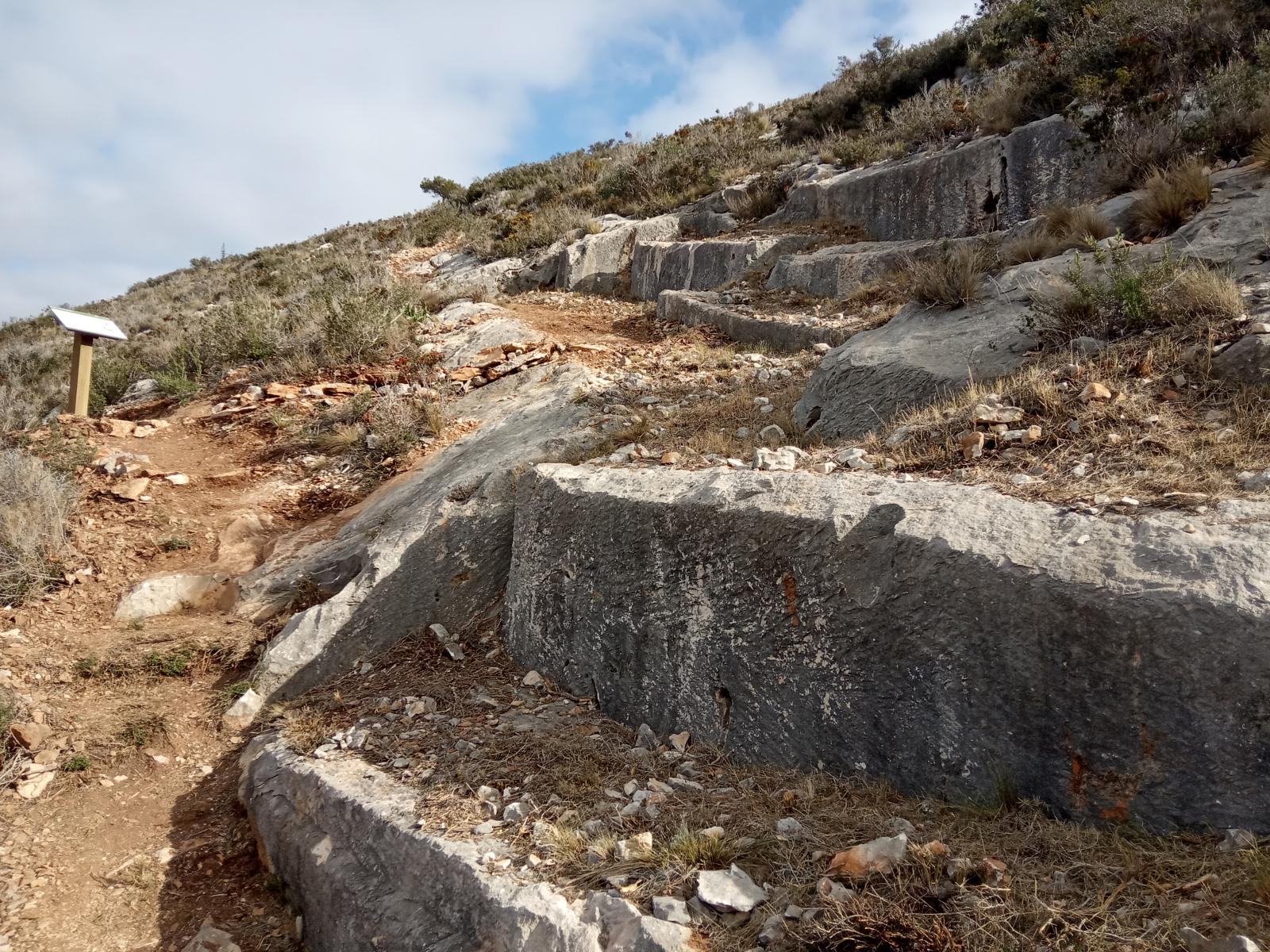
In November 2018, during improvement works on the Camí de la Serp – Puig de la Llorença – Cala Llebeig Route, the remains of an ancient limestone quarry, probably dating from the Roman period, were discovered.
Although at first glance it may appear to be simply a stepped rock surface, the surviving marks reveal an ancient extraction site and provide an insight into the techniques used by quarry workers to obtain blocks of stone.
Stone as a resource
Limestone extracted from this type of quarry could be used for many different purposes. In architecture, it was used to produce ashlar blocks and voussoirs, but it could also be employed in hydraulic channels or to manufacture components for presses and mills.
The process began directly at the quarry, where workers selected and extracted the blocks. Once separated from the bedrock, the stone was roughly shaped to remove irregularities and make it easier to transport and finish.
How a block was extracted
Quarrying followed an organised process. First, vegetation, soil and surface materials were removed to expose suitable bedrock.
Once the quarry face had been prepared, extraction generally progressed from the outside inwards and from top to bottom, gradually creating different levels or steps.
To extract a block, its outline was first marked by cutting a groove approximately ten centimetres deep. A series of small holes was then made along this line using percussion tools, and wooden or iron wedges were inserted into them.
The pressure exerted by the wedges gradually opened the fracture until the block could be separated from the bedrock in a controlled manner.
A block that was never extracted
One of the most interesting features preserved at the quarry is a block that was marked out for extraction but was never separated from the rock.
The marks made by the quarry workers can still be seen, allowing visitors to observe one of the stages of the extraction process directly. This feature makes the site a kind of open-air archaeological demonstration of ancient quarrying techniques.
The dimensions of the blocks appear to follow standardised measurements related to the Roman foot, equivalent to approximately thirty centimetres, or multiples of this unit. This is one of the indications supporting the possible Roman chronology of the quarry.
Traces of quarrying
The continuous extraction of stone gradually transformed the surface of the rock. Each new quarry face left behind steps and cut surfaces, eventually creating the terraced appearance that characterises the site today.
Grooves, cuts, tool marks, outlined blocks and changes in level make it possible to reconstruct how quarrying was carried out directly on the site.
Once extracted, the blocks were roughly shaped and regularised before being transported elsewhere for their final finishing according to their intended use.
A landscape transformed by people
The Ancient Quarry reveals a different dimension of the landscape of Puig Llorença. The same limestone that today forms the mountains and cliffs was also, at some point in history, a resource used by the communities that inhabited this territory.
The site lies beside the Camí de la Serp – Puig de la Llorença – Cala Llebeig Route, an itinerary that passes along old paths, agricultural terraces and other features associated with the traditional use of the landscape.
The marks preserved in the rock make the Ancient Quarry a valuable record of how people transformed the landscape to obtain one of the fundamental materials used in architecture and everyday life in Antiquity.