

ES
EN
VA
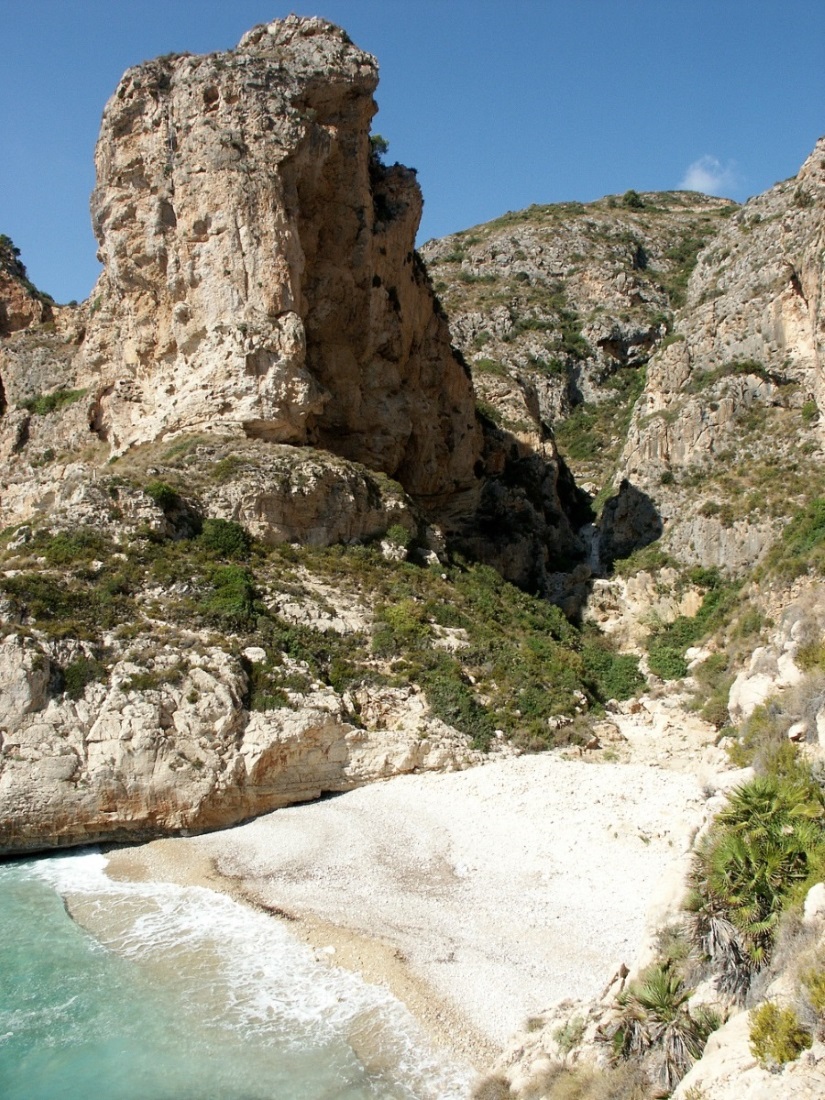
Cala dels Testos is a small, secluded cove with crystal-clear waters, sheltered beneath the imposing cliffs of Puig Llorença. Its virtually untouched surroundings and challenging access through the Barranc dels Testos, including several sections equipped with ropes, make it one of the most distinctive and unspoilt spots along the coastline of El Poble Nou de Benitatxell.
Cala dels Testos is a small, unspoilt cove located in one of the most rugged and secluded corners of the El Poble Nou de Benitatxell coastline. Enclosed by towering rock walls and dominated by the imposing Morro Falquí, it preserves an almost untouched landscape where the cliffs plunge directly into the clear waters of the Mediterranean.
Its isolation, absence of buildings and unusual access through the Barranc de l’Infern make Testos very different from other coves: reaching it is part of the experience itself.
The cove lies at the mouth of the Barranc de l’Infern ravine, whose channel descends between the cliffs until it reaches the Mediterranean.
Its south-facing shoreline consists mainly of gravel and pebbles and is sheltered by the great rock walls that characterise this section of the coastline.
Above the cove rises Morro Falquí, an impressive rocky promontory standing more than 100 metres above sea leveland forming one of the most recognisable coastal profiles in Benitatxell.
The combination of the ravine, the cove and the enormous wall of Morro Falquí creates a landscape defined by verticality and reveals how directly the mountains meet the Mediterranean along this part of the coast.
Cala dels Testos has no road access. It can only be reached by sea or on foot via the Ruta dels Testos.
The walking route follows the final section of the Barranc de l’Infern. Although the distance is relatively short, the route is considered difficult due to its steep gradient, rocky terrain and the drops that must be negotiated before reaching the cove.
The final part of the route includes three sections with ropes provided as an aid, helping walkers negotiate the steepest points during both the descent and the return climb.
These ropes do not remove the difficulty of the route: walkers need to be confident moving over rugged terrain and should remember that, after reaching the cove, the same steep sections must be climbed again on the return journey.
Between the second and third sections of the descent lies the Cova dels Testos, a natural cavity in the rock face.
As well as serving as a landmark along the route, the cave forms a spectacular natural viewpoint over the Mediterranean, offering an extensive panorama of the coastline to the south.
Its position partway down the route provides a different perspective on the enormous verticality of Morro Falquí and the surrounding cliffs before continuing towards the cove.
Cala dels Testos forms part of the Penya-segats de la Marina, a protected area included in the Natura 2000 Networkas both a Special Area of Conservation (SAC) and a Special Protection Area for Birds (SPA).
The great limestone walls support plant communities adapted to extreme conditions of wind, salinity and limited soil, while the least accessible areas provide valuable refuge for different species.
The absence of urban development and the difficulty of access have helped preserve the natural character of this section of coastline.
The landscape continues beneath the Mediterranean. The seabed combines large rocky blocks, small sandy areas and Posidonia oceanica seagrass meadows.
This variety of seabed habitats supports different forms of marine life and makes Testos particularly interesting for observing the underwater Mediterranean landscape when sea conditions are suitable.
Posidonia meadows also play a fundamental role in the Mediterranean ecosystem, providing shelter and breeding areas for numerous species and helping to maintain the clarity and quality of the water.
Before or after visiting the cove, the Mirador dels Testos offers an elevated perspective over the same landscape.
From the viewpoint, visitors can see the mouth of the Barranc de l’Infern, the small cove enclosed by the cliffs and the impressive silhouette of Morro Falquí, providing a complementary perspective to the experience at sea level.
Type: natural cove with gravel and pebbles
Orientation: south
Setting: cliffs and protected natural area
Beach services: no services
Access: on foot via the Ruta dels Testos or by sea
Difficulty of access on foot: high
Highlights: Barranc de l’Infern, Morro Falquí and Cova dels Testos
Seabed: rock, sand and Posidonia oceanica seagrass meadows
Important: access on foot involves steep terrain and three sections with ropes provided as an aid. Suitable footwear, sufficient drinking water and sun protection are essential, and walkers should be accustomed to moving over rugged terrain. The route and access to the cove should be avoided in adverse weather or sea conditions.
Cala dels Testos preserves one of Benitatxell’s wildest landscapes: a ravine descending directly into the Mediterranean, a small cove hidden between the cliffs and Morro Falquí rising more than one hundred metres above the sea.
You have 0 favourites in your list.
View the full list in My favourites.

Add your favourite places to your list. You can then manage them and send them to your mobile from My favourites.