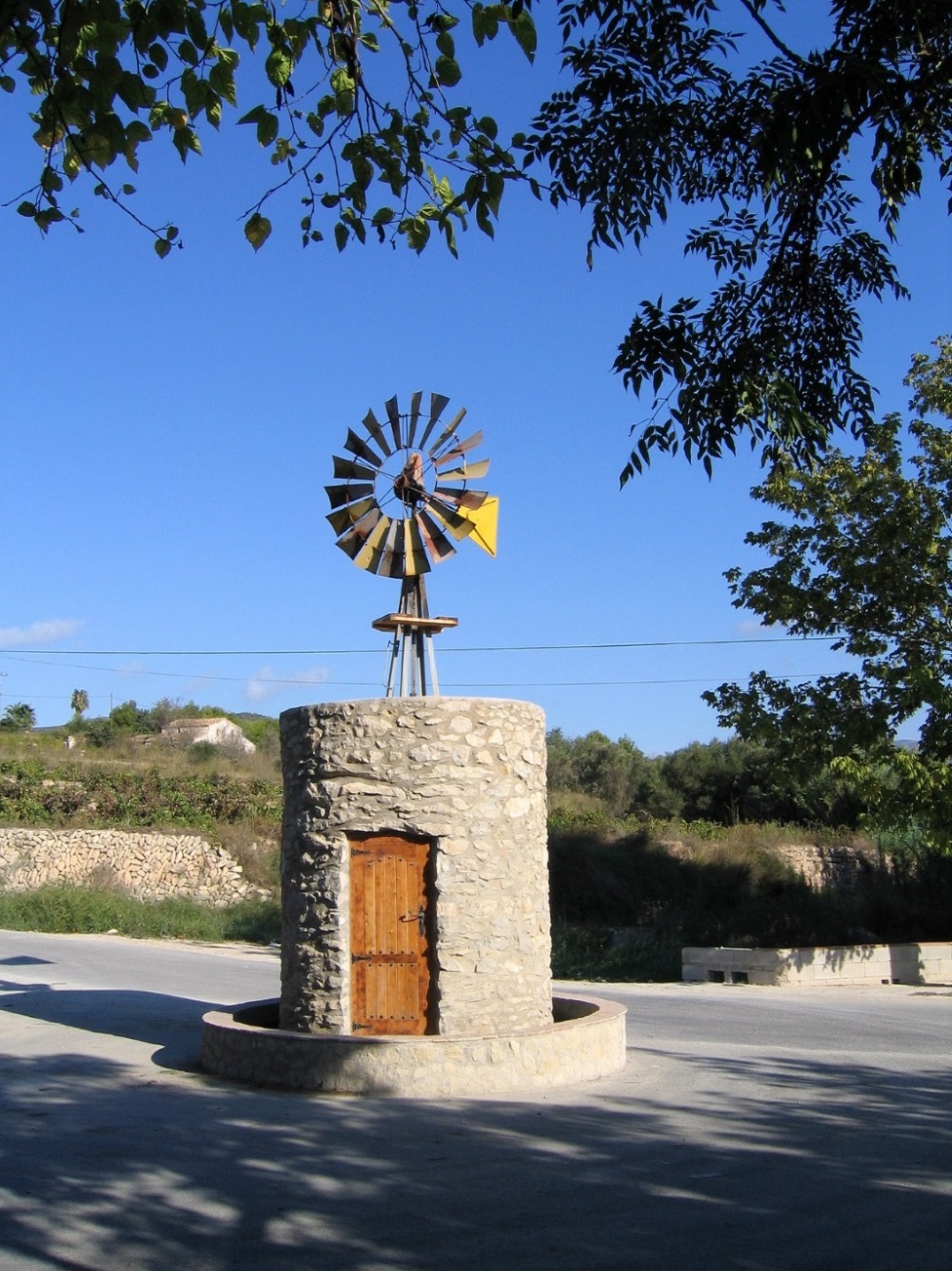
The Pous de l’Abiar form a traditional hydraulic complex located in the lower part of the l’Abiar area, closely linked for generations to water supply, agriculture and everyday life in El Poble Nou de Benitatxell.
The complex consists of wells and underground reservoirs designed to collect, store and make use of the water available in this area. Its configuration reflects a long process of adaptation to a Mediterranean landscape where securing a regular supply of water has always been essential.
It is thought that the system may be related to the hydraulic knowledge and techniques developed during the Andalusi period, although the structures evolved and were adapted to the changing needs of the local population over time.
The culture of water
In a region characterised by irregular rainfall and long dry periods, wells, cisterns and other water collection systems played an essential role for centuries.
The Pous de l’Abiar made it possible to use the available water and became one of Benitatxell’s traditional water supply points. Local residents continued to collect water from these wells until the 1990s, maintaining well into the 20th century a practice inherited from previous generations.
Their function, however, extended far beyond domestic consumption. The water was also used to irrigate vegetable gardens and as a watering place for livestock, making the site closely connected to agricultural and farming activities.
A meeting place
The need to collect water made the wells much more than hydraulic infrastructure. They were also places of meeting and social interaction, closely linked to the everyday tasks of the municipality’s inhabitants.
A public washhouse also once stood nearby, where women traditionally came down from the village to wash clothes using water from the wells.
For decades, the washhouse formed part of Benitatxell’s everyday and social life. As in many Mediterranean villages, these places were spaces for work, but also for conversation and social interaction among those who regularly used them.
The building was eventually demolished in the 1970s, although its memory remains closely associated with the history of the Pous de l’Abiar.
Wells and water extraction
The complex preserves several features associated with the use of water. In addition to the wells, there is a structure with a windmill, which was used until relatively recent times to facilitate water extraction and supply.
Two other wells also survive nearby, forming a small complex that illustrates the different solutions used to obtain and make use of groundwater.
These structures show how rural communities gradually incorporated and adapted different techniques to meet the same fundamental need: ensuring access to water.
A landscape inhabited for centuries
The l’Abiar area also preserves important evidence of much earlier human occupation. Nearby is the Cova de les Bruixes, one of the municipality’s most important archaeological sites.
Excavations at the site have documented remains from different periods as well as structures associated with the Andalusi settlement of Alabiar, mentioned in written sources in 1277.
This connection places the Pous de l’Abiar within a broader historical landscape in which the availability of water, agricultural land and human settlement have been closely linked for centuries.
A landscape that remains alive
Today, the Pous de l’Abiar retain their value as a reminder of Benitatxell’s traditional culture of water.
Beside the wells there is a small rest area and ecological community gardens, maintaining the historic connection between this place, water and agriculture.
Although the wells no longer perform the essential water-supply function they once provided for generations, the site still recalls a time when every source of water was of enormous importance to the community.
The Pous de l’Abiar are therefore much more than a group of old hydraulic structures: they preserve the memory of how Benitatxell learned to collect, use and share one of the Mediterranean landscape’s most valuable resources: water.