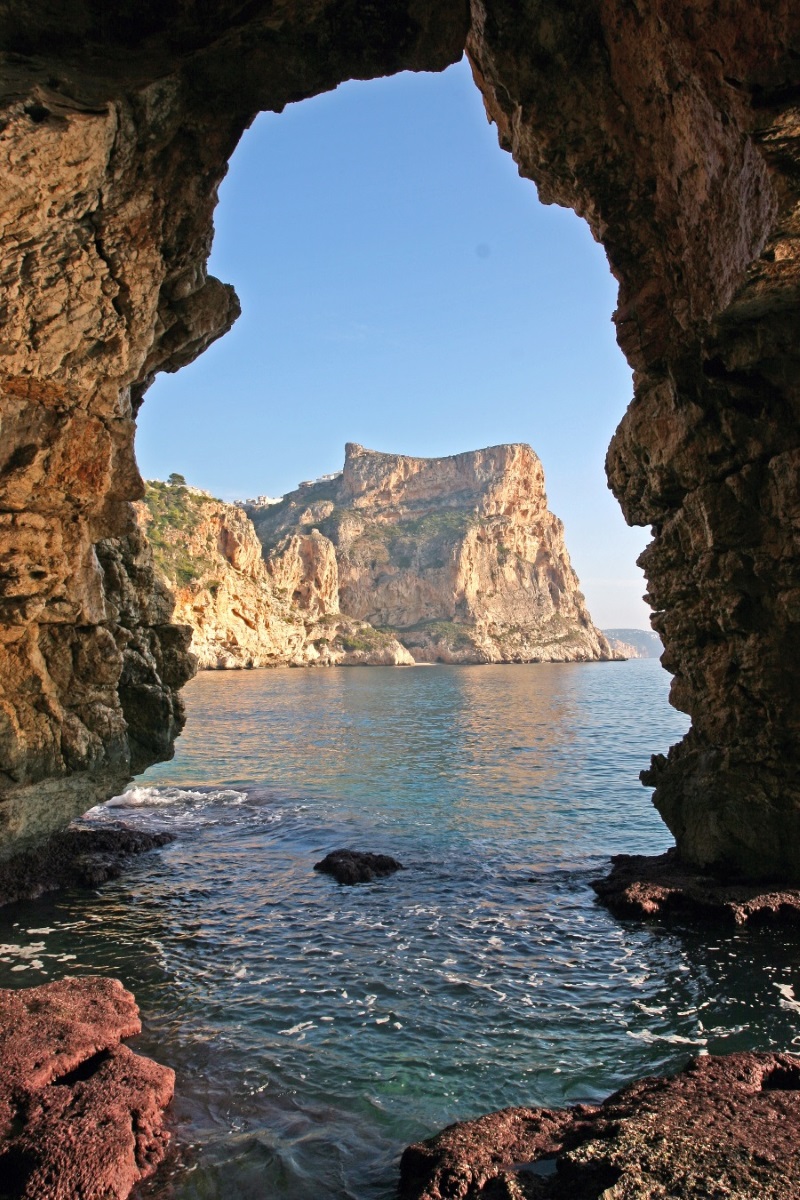
The Cova dels Arcs, located at one end of Cala del Moraig, is one of the most emblematic natural formations in El Poble Nou de Benitatxell and one of the most recognisable geological features of its coastline. Its great arches opening onto the Mediterranean and the light entering through its cavities create a striking sight, but its true significance lies in the geological history it preserves.
An ancient karst cavity
The Cova dels Arcs is one of the finest examples of a karst system that has evolved from continental or coastal conditions to a submerged marine environment.
The cavity initially developed above water through processes characteristic of karst landscapes. Water infiltrating and circulating through fractures gradually dissolved the limestone, enlarging its passages and cavities over time.
As sea levels subsequently rose, the system was flooded and became part of the underwater environment. Since then, the Mediterranean has continued to transform it through wave erosion and the dissolution of the limestone.
Arches shaped by the Mediterranean
Erosion acts most intensely on areas of rock containing fractures, discontinuities or greater porosity. Over time, wave action gradually enlarged these weaker points until parts of the outer walls of the cavity were breached, creating the spectacular natural arches that give the cave its name.
From inside the cave, when sea conditions permit, light enters through two large arches and an opening in the roof, creating one of the most distinctive views at Cala del Moraig.
The cave continues to be shaped by the action of the sea, making it an outstanding example of a geological landscape that is still evolving.
Rocks with millions of years of history
The Cova dels Arcs is formed within Eocene limestone, dating back tens of millions of years. These rocks contain abundant nummulites, small marine fossils with an approximately circular shape that can be observed in some of the surrounding rock outcrops.
Their presence reveals the marine origin of these limestone formations and provides another key to understanding the extraordinary geological history of Cala del Moraig.
Part of a major geological system
The Cova dels Arcs is not an isolated formation. It forms part of the complex geological landscape of Moraig and is closely connected to the Moraig Fault and the karst system of the Benissa aquifer.
A short distance to the south lies the Riu del Moraig or Riu Blanc, an active submarine spring through which the aquifer discharges into the Mediterranean via an extensive network of submerged galleries and passages.
Also nearby is La Vasenilla, a large collapse doline that illustrates another stage in the karst processes that continue to transform this coastline.
Together, the Cova dels Arcs, the Moraig Fault, Riu Blanc and La Vasenilla form an extraordinary natural complex where it is possible to interpret millions of years of tectonic movement, rock dissolution and marine erosion.
The Cova dels Arcs is therefore much more than one of Benitatxell’s great landscape icons. Its arches are the visible expression of a complex geological history that continues to unfold beneath the waters of the Mediterranean.