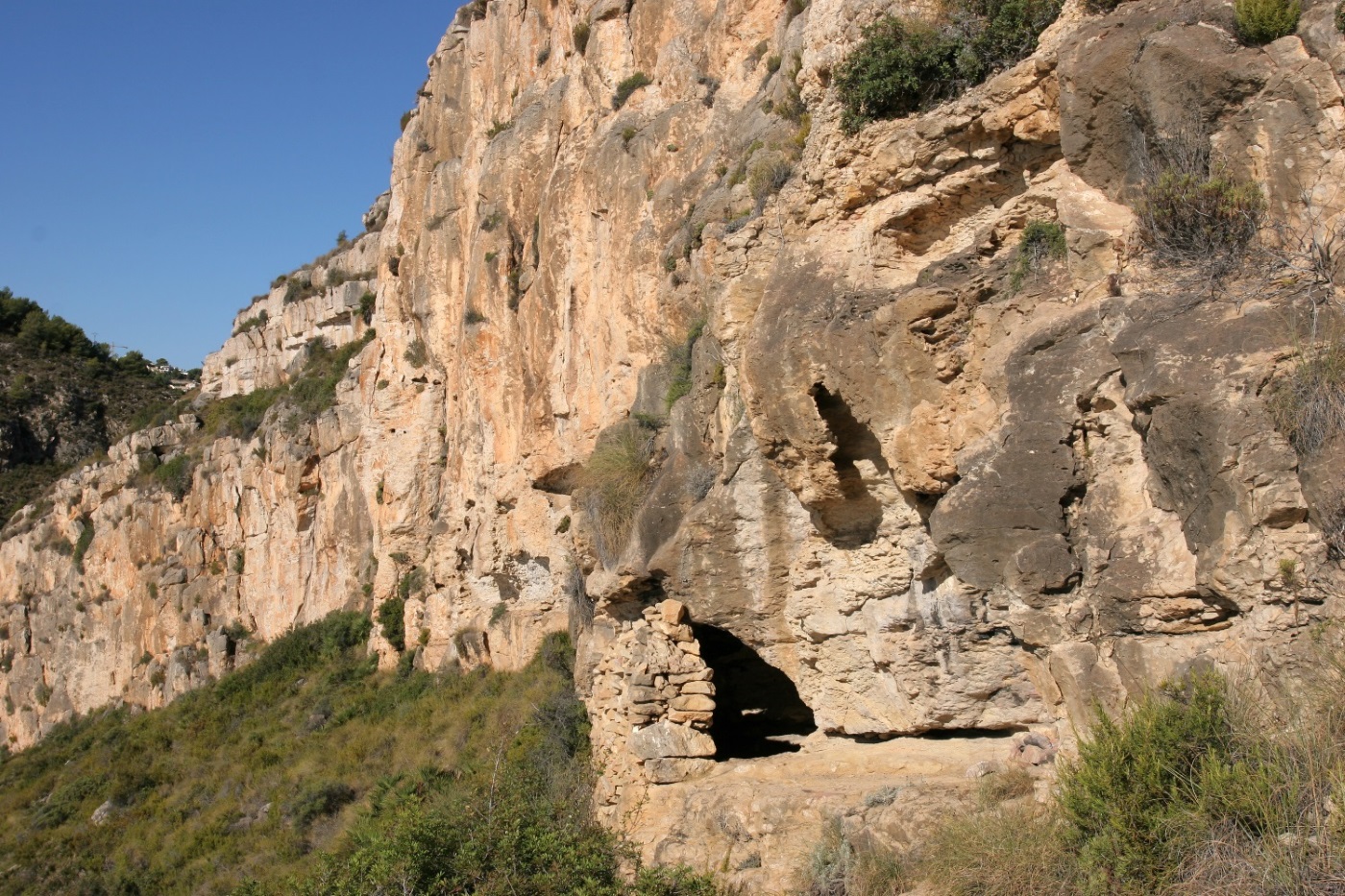
Along the great cliffs of El Poble Nou de Benitatxell, numerous traditional caves and shelters survive as part of one of the most distinctive ethnographic heritage landscapes on the Marina Alta coastline.
These structures can be discovered particularly along the Ruta dels Penya-segats – Moraig-Llebeig, which connects Cala del Moraig with Cala Llebeig along the base of the cliffs.
Built mainly between the late 19th and early 20th centuries, the caves bear witness to a time when fishermen and farmers made use of even the most rugged and inaccessible corners of the coastline.
Shelters built into the rock
The coastal caves are very simple structures built around natural cavities and rock shelters in the cliffs. Wherever the rock provided sufficient protection, the space was partially enclosed with walls constructed mainly using the traditional dry-stone technique.
In this way, the cliff itself served as the roof and part of the structure, while the walls completed the shelter and protected its interior from the sun, wind, rain and damp conditions.
Most had a single small entrance and an interior with few or no divisions. Their simplicity reflects their purpose: these were not permanent homes, but practical spaces designed to make working and spending short periods on the coast possible.
Fishermen and farmers
The main users of these caves were fishermen and farmers from Benitatxell, who descended to this difficult stretch of coastline to carry out different activities.
Fishermen used them as places to shelter, rest or store some of their equipment. Farmers, meanwhile, cultivated the small areas of available land between the rock faces, even in places very close to the sea.
Around some of the caves, dry-stone retaining walls, agricultural terraces and small cultivated areas can still be recognised, bearing witness to the considerable effort required to make use of a landscape characterised by steep slopes and difficult access.
Fire, animals and everyday life
Although their interiors were very simple, different spaces could be created around the caves to meet the needs of those who spent time there.
Some shelters preserve areas used for lighting fires, stone benches, small ovens and places for storing tools. There were also enclosures used to shelter pack animals, essential for transporting goods and materials along the narrow paths connecting the coast with the village.
These features provide an insight into everyday working life in an isolated environment, where every cavity, wall and available space had a practical purpose.
Shelters used for smuggling
The coastal caves are also associated with another aspect of Benitatxell’s popular history: smuggling.
The rugged configuration of the cliffs, the presence of small coves and the difficulty of observing certain areas from inland made this coastline well suited to discreet landings.
According to local tradition, some caves were used as hiding places while people waited for the arrival of llaüts and sailing vessels, carrying goods such as tobacco, textiles and other products.
This activity forms part of the memory of a coastline that, for centuries, served simultaneously as a place of work, communication and refuge.
Caves with their own names
Many of these structures still preserve the names or nicknames of the people who once used them, keeping alive the memory of those who worked in this landscape.
Among them are the Cova de les Morretes, Cova del Tio Domingo l’Abiar, Cova de Pepet del Morret, Cova del Tio Toni el Senyalat and Cova del Morro del Bou.
Each has its own characteristics. Some are small shelters enclosed by a single wall, while others preserve more complex structures including ovens, stone benches, animal enclosures and other spaces.
Heritage integrated into the landscape
The caves lie within the protected Penya-segats de la Marina area, included in the Natura 2000 Network as both a Special Area of Conservation (SAC) and a Special Protection Area for Birds (SPA).
Their importance lies not only in the structures themselves, but also in the remarkable integration of traditional architecture and landscape. Local people took advantage of the natural shape of the rock and used materials available in the immediate surroundings, making minimal alterations to create spaces adapted to their needs.
Today, walking the Ruta dels Penya-segats allows visitors to discover these structures within the very landscape for which they were created. The caves, old paths, agricultural terraces and dry-stone walls together preserve the memory of the people who learned to work and make use of one of the most rugged landscapes on the Marina Alta coastline.