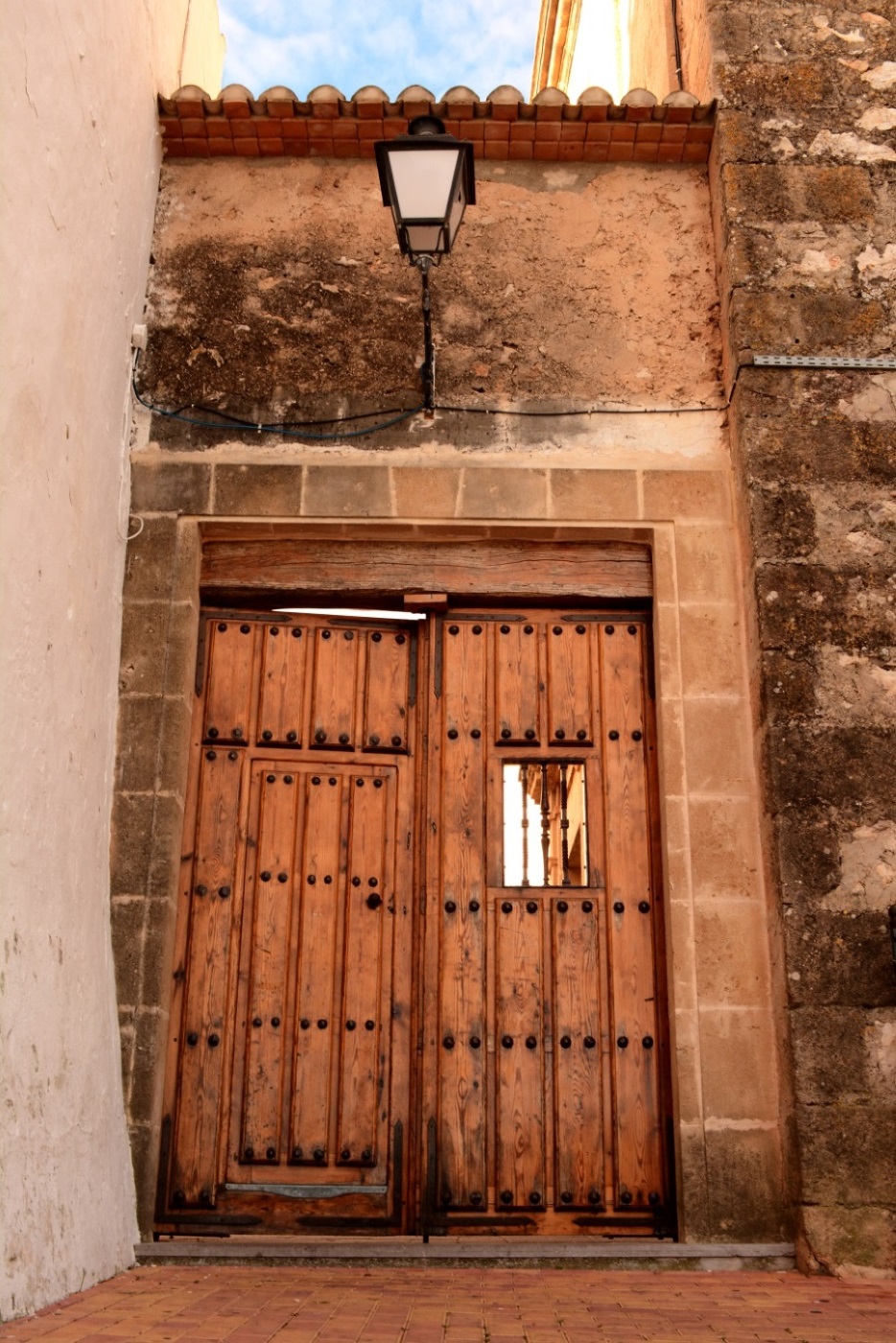
El Portalet is one of the historic gateways to the heart of the old town of El Poble Nou de Benitatxell. Located beside Plaça de l’Església, this small passage preserves the memory of the original layout of the settlement and is one of the most distinctive features of its historical heritage.
Passing through it takes visitors, in just a few metres, from the streets and buildings of the historic centre to an extensive panorama of fields, mountains and the Mediterranean.
A gateway to old Benitatxell
El Portalet formed part of the original enclosure that protected the medieval settlement, established on one of the municipality’s elevated areas.
The configuration of the terrain contributed to the natural defence of the settlement. This was complemented by the walls of the Church of Santa María Magdalena, the rear façades of the houses and other structures that helped create a compact and protected urban area.
El Portalet provided a connection between this space and the outside, serving as one of the passages towards the agricultural landscape surrounding the settlement.
Traces of the medieval settlement
Although the growth of the town gradually transformed this defensive configuration, the layout of the historic centre still preserves some of its characteristics.
Narrow streets, the arrangement of the houses and the dominant position of the church reflect an urban model shaped by the topography and by the need to concentrate buildings within a protected area.
In this context, El Portalet is particularly significant because it allows visitors to read part of Benitatxell’s historical evolution directly through its urban layout.
From defensive entrance to everyday passage
As the municipality grew and changed, El Portalet lost its former role within the defensive enclosure and became fully integrated into everyday life in the town.
What was once an entrance to the settlement became a small passage connecting Plaça de l’Església with the landscape extending behind the houses.
This continuity of use has allowed El Portalet to remain integrated into the present-day urban fabric while preserving its value as evidence of Benitatxell’s medieval origins.
A gateway opening onto the landscape
One of the most striking aspects of El Portalet is revealed when passing through it from Plaça de l’Església. After leaving the historic centre behind, the landscape suddenly opens onto the fields and mountains of the Marina Alta.
Beside the old passage is the Mirador del Portalet, offering an extensive panorama of the surrounding territory.
In the foreground lies the traditional agricultural landscape, with fields and old cultivation terraces. Montgó dominates the horizon, while towards the coast the view opens over the Bay of Xàbia, framed by Cap de Sant Antoni, and extends as far as Cap de la Nau.
This immediate transition between architecture and landscape is one of the site’s greatest attractions: within just a few steps, visitors move from the heart of the old town to an open view over the territory that historically surrounded and sustained it.
Discovering the historic centre
El Portalet forms part of the Urban Route, an itinerary that introduces visitors on foot to some of the main historical and architectural features of El Poble Nou de Benitatxell.
Its proximity to the Church of Santa María Magdalena, Plaça de l’Església and other elements of the old town helps reveal how the historic settlement was organised and how it evolved over the centuries.
In this small space, El Portalet brings together much of the essence of the old town: history, architecture and landscape. An ancient gateway of Benitatxell that continues, almost literally, to connect the present-day town with its past and with the territory stretching out below.