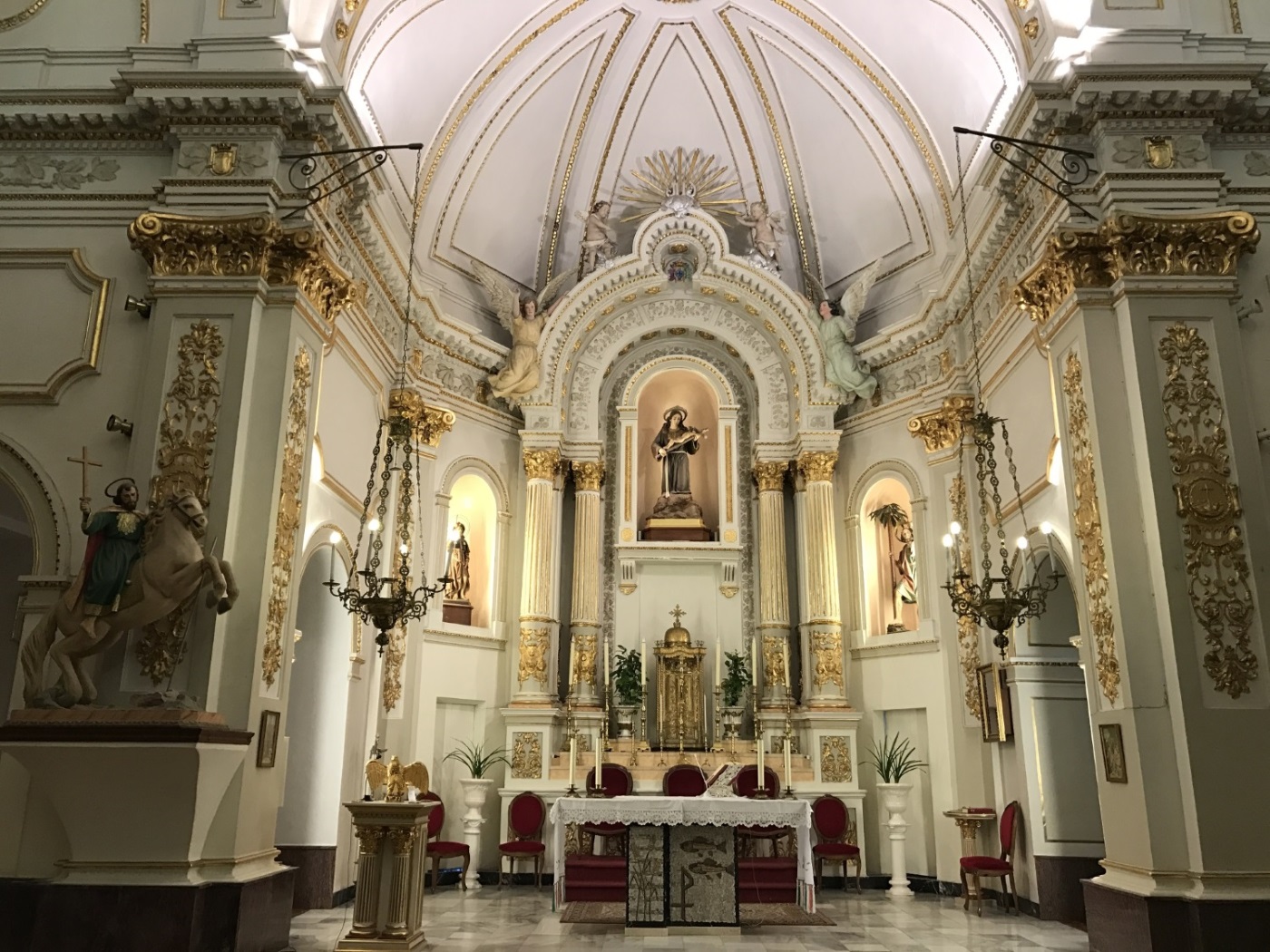
At the highest point of the town stands the Church of Santa María Magdalena, the parish church of El Poble Nou de Benitatxell and one of the main architectural and visual landmarks of its historic centre.
Built between 1710 and 1774 on the site previously occupied by an old hermitage, the church is the result of more than three centuries of history. Successive extensions and renovations gradually transformed the building into the one seen today.
From the old hermitage to the parish church
Construction of the church began in the early 18th century, on the site of a pre-existing hermitage.
In its original layout, the church had three chapels on each side, with the high altar positioned along the central axis. This principal space was dedicated to Santa María Magdalena, patron saint of the parish, together with Saint Roch and Saint Christopher.
Its elevated position at the heart of the old settlement made the church one of Benitatxell’s main landmarks from its earliest days.
The major transformation of 1911
One of the most important interventions in the history of the church took place in 1911.
During this renovation, the dome acquired its distinctive covering of blue and white tiles, which over time became one of the most recognisable features of the municipality’s skyline.
The work was considerably more extensive. The Communion Chapel, the steps of the presbytery and the gallery behind the high altar were also built, while the flooring and interior decoration were renovated.
This intervention significantly transformed the church and helped define much of the appearance it retains today.
The bell tower and façade
Renovations continued during the first decades of the 20th century.
In 1921, the bell tower was raised, further strengthening the church’s presence in the town skyline. Its position at the highest point of the urban centre makes the tower visible from numerous locations throughout the municipality and a visual landmark for identifying Benitatxell from a distance.
Work was carried out on the main façade in 1953, while the bell-tower clock was installed in 1961.
These successive interventions gradually completed the exterior appearance of the complex.
Architecture shaped by different periods
The building’s long evolution explains the coexistence of several architectural influences.
The interior is predominantly restrained Baroque with Neoclassical elements, reflecting both the original construction and subsequent renovations.
Some Neo-Gothic influences can be seen on the exterior, particularly in certain elements of the bell tower.
The main façade has a simple, balanced composition and is distinguished by a niche dedicated to Santa María Magdalena, reinforcing the religious identity of the building.
At the heart of old Benitatxell
The church cannot be understood simply as an isolated building. Its location is directly connected to the historical layout of the settlement.
Beside Plaça de l’Església is El Portalet, one of the historic entrances to the original enclosure that protected the medieval settlement. The walls of the church, the rear façades of the houses and the natural topography all helped define this compact space.
Passing through El Portalet leads to the Mirador del Portalet, where the landscape opens towards the fields of Benitatxell, Montgó and the Bay of Xàbia.
This close relationship between church, historic gateway and landscape helps reveal the connection between architecture, urban development and territory in the origins of the town.
A symbol of the town skyline
The Church of Santa María Magdalena forms part of the Urban Route, which explores some of the main historical and architectural features of the old town.
Its elevated position, bell tower and distinctive blue-and-white tiled dome make the church visible from many points in the surrounding landscape.
Seen from a distance, Benitatxell has a characteristic stepped silhouette crowned by the church tower. Santa María Magdalena is therefore much more than the municipality’s principal place of worship: it is one of the great architectural and landscape symbols of El Poble Nou de Benitatxell.